What Is AI Agent Identity? Verifying the Agents Reaching Your Site
Jamie Vinkle
Bot & AI Agent Trust Management
August 19, 2026
-
AI agent identity is the set of signals used to establish what an automated agent is, who operates it, and whether its presented identity matches the entity behind it.
-
The term covers two distinct problems: identity an organization issues to agents it operates, and identity it verifies for external agents that arrive with no account or credential.
-
An external agent’s identity is assembled from multiple signal layers (declared, network, provenance, and behavioral). No single signal proves it.
-
A declared identity is a claim, not proof. It can be omitted, changed, or copied from a trusted agent.
-
Standards are developing on both sides, but no universal identity mechanism exists yet, so verification depends on corroborating signals.
-
Identity establishes who an agent appears to be, not what it intends to do. It is the foundation of a broader trust decision, not the whole decision.
AI agent identity is the set of signals used to establish what an automated agent is, who operates it, and whether the identity it presents matches the entity behind it.
The broader phrase AI identity often refers to the same idea. AI agent identity is the precise version: the identity of the individual automated agents that browse, request, and act on websites, applications, and APIs.
For most of the web’s history, those sites and systems had a reliable way to know who they were dealing with: an account or a credential. That worked because the actors were people, or software that people had built and registered.
AI agents break that assumption. Many arrive with no account, no credential, and no prior relationship.
This guide covers what AI agent identity means, the two different problems the term refers to, what makes up an agent’s identity at the perimeter, why it is difficult to verify, the standards forming around it, and why identity is the foundation for the decisions that follow.
What Is AI Agent Identity?
AI agent identity answers a specific question: which automated actor is making this request, and who is responsible for operating it?
It is not the same question as what an agent can do. An agent may be capable of browsing a catalog, submitting a form, or completing a transaction, and none of those capabilities establish who it is or who stands behind it.
The term is surfacing now because AI agents have moved from demonstrations into real production traffic, part of the broader shift toward an agentic web.
One measure of that shift: Microsoft’s 2026 Work Trend Index reported that the number of active agents within its Microsoft 365 ecosystem increased 15 times year over year, and 18 times within large enterprises.
That growth puts pressure on how digital identity has always worked. Traditional identity models depend on an established relationship: a user creates an account, an employee receives an enterprise identity, an application receives an API key, a known device is tied to an authenticated user.
External AI agents often arrive with none of that context. Organizations that recognize visitors through accounts, logins, and known devices are finding that autonomous agents do not fit that model, so identity has to be evaluated from the signals available in and around the request.
The Two Sides of AI Agent Identity: Identity You Issue vs. Identity You Verify
AI agent identity means one thing when you operate the agent, and another when an unfamiliar agent arrives at your site.
Identity you issue applies to agents an organization builds, deploys, or manages.
The organization can register each agent, issue credentials, associate it with an owner, and define what it is allowed to access. This is an identity and access management problem, and it is what most current writing on AI agent identity addresses.
A retailer that deploys an internal pricing agent, for example, needs to know which agent is acting, which team owns it, and what data it is authorized to access.
This side overlaps with what enterprise teams call non-human identity: credential and access management for the service accounts, workloads, and agents an organization operates internally.
Identity you verify applies to agents arriving from outside.
A third-party agent reaching a website, application, or API may arrive without an account or credential the receiving organization issued. The organization still has to establish what the agent is, who runs it, and whether its presented identity is genuine.
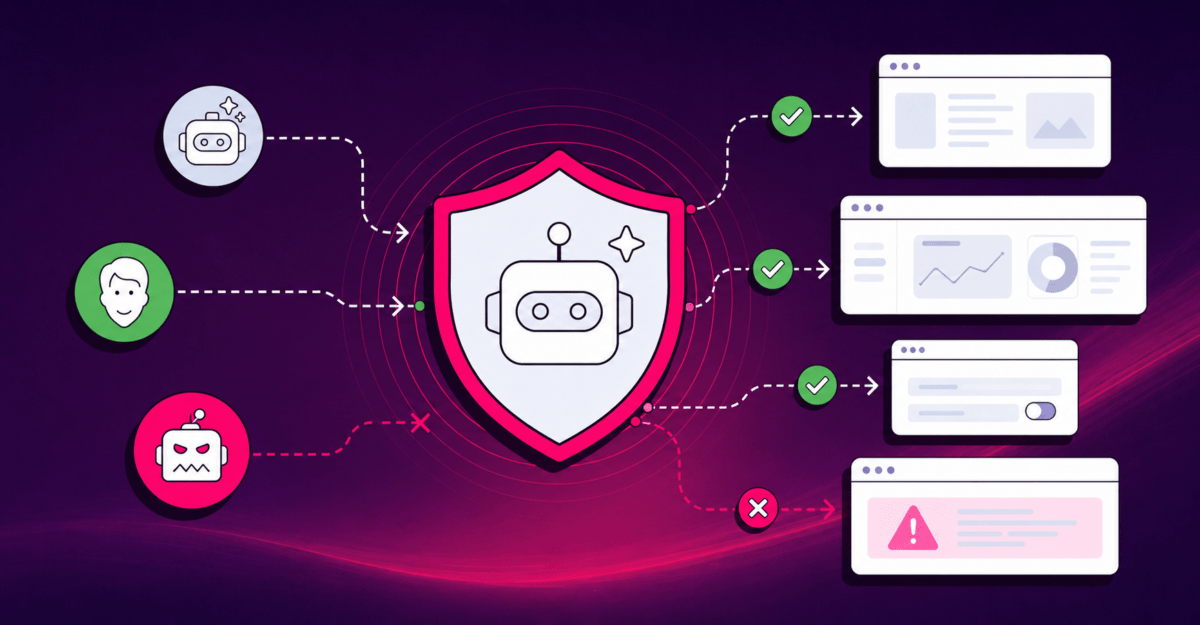
This is the problem most sites face first, and the reason tools exist to classify and govern agent traffic across humans, bots, and agents.
The same retailer lands on the other side of the line when a shopping agent visits its product pages on behalf of a consumer: it never built the agent and never issued its credentials, so it can only verify the agent, not authenticate it.
The distinction matters because the two problems require different systems. Provisioning, credentials, and delegation govern the issued side. They say nothing about whether an unfamiliar agent at a checkout page is genuinely associated with the platform it claims to represent.
Here is how the two sides compare.
Both sides matter, but they are not interchangeable.
What Makes Up an AI Agent’s Identity at Your Perimeter
When an unfamiliar agent reaches a site, its identity has to be read from the evidence it presents and the independent signals available to the receiving organization.
No single signal, especially a declared one, is sufficient. Identity at the perimeter is assembled from four signal layers that corroborate or contradict the agent’s claim. The table below orders them from the easiest to fake to the hardest.
| Signal Layer | What It Shows | Primary Limitation |
|---|---|---|
| Declared identity | The agent, product, crawler, or platform the request claims to represent | Self-reported values can be changed, copied, or omitted |
| Network and origin signals | Whether the request’s infrastructure and routing are consistent with the claimed operator | Traffic may use shared cloud infrastructure, intermediaries, proxies, or unrelated networks |
| Provenance and operator signals | Evidence connecting the agent to a platform, organization, owner, or delegation chain | Stronger evidence may not be available for every agent or request |
| Behavioral context | Whether activity over the session is consistent with the presented identity and expected use | Behavior develops over time and cannot independently prove identity |
Here is a closer look at each signal layer.
Declared Identity
Declared identity is the information an agent presents about itself, most commonly a user-agent string, sometimes headers, metadata, or another self-reported label.
It is the starting point of verification, not the conclusion. An agent can present its identity accurately, partially, generically, or falsely, and nothing about the label itself shows which.
Network and Origin Signals
Network and origin signals test whether the infrastructure behind a request is consistent with the operator the agent claims. Relevant evidence includes IP ownership, autonomous system data, published operator address ranges, and reverse DNS records.
These signals are harder to reproduce than a user-agent string, but traffic routed through shared cloud services, proxies, or intermediary platforms can obscure the actual operator. Network origin can support or contradict an identity claim; it rarely proves one on its own.
Provenance and Operator Signals
Provenance and operator signals connect the agent to the platform, organization, or user behind it through evidence such as cryptographically signed requests, platform-issued attestations, published verification records, and delegation chains.
This evidence is stronger because it sits outside the agent’s own self-description. It can also clarify responsibility, since a single agent may involve several parties: the platform, the application developer, the deploying organization, and the user directing it.
Visibility at this layer is central if you need to govern AI agents and large language models across your digital properties.
Behavioral Context
Behavioral context checks whether an agent’s activity over a session is consistent with the identity it presents and its expected purpose.
Behavior cannot establish identity on its own; its value is corroborative. A credible declared identity becomes less credible when the session’s activity conflicts with how the claimed operator behaves.
Why Verifying an AI Agent’s Identity Is Difficult
Verification is difficult because a presented identity is a claim, not proof.
An agent can omit its user-agent string, change it, or copy the one a known, trusted agent uses. The challenge is compounded by scale: the volume and variety of agents reaching digital properties are growing quickly, and legitimate and unwanted agents can look nearly identical at the request level. There is also no universal way for an agent to prove who it is yet.
That produces three hard cases, and the same request shape can mean any of them.
Agents That Declare Themselves Honestly
Some agents present a clear identity and originate from infrastructure consistent with the operator they claim to represent.
This is the most straightforward case, but the declared identity and the independent evidence still have to be checked against each other.
Agents That Provide No Meaningful Identity
Other agents present no explicit claim at all: no user-agent string, a generic browser identity, or an application that hides the underlying agent platform.
With nothing declared to validate, the organization has to rely on what the request, the session, and the behavior reveal on their own.
Agents That Impersonate a Known Identity
An agent can copy the declared identity of a trusted assistant, crawler, or browser to inherit its reputation and the access that comes with it.
The declared identity can look correct even when the infrastructure and operator evidence behind it do not support the claim. This is where calibrated controls for automated scrapers apply, since scraper impersonation relies on the same technique.
Impersonation also overlaps with deliberately deceptive automation. Detecting malicious AI agents and synthetic interactions covers that side of the problem in more depth.
The Emerging Standards Shaping AI Agent Identity
Identity standards are developing on both sides of the issue-versus-verify distinction, and none is universal yet.
Standards for Identity an Organization Issues
The issued side is more mature because it builds on established identity and access management practice.
In October 2025, the OpenID Foundation published the Identity Management for Agentic AI whitepaper through its Artificial Intelligence Identity Management Community Group. The whitepaper addresses how agents should authenticate, how authority is delegated, and how agent activity is audited.
The Cloud Security Alliance has published guidance for agentic AI identity and access management that treats agents as first-class identities, dynamic, delegated, and often short-lived, rather than static service accounts.
Microsoft Entra Agent ID extends Microsoft’s enterprise identity platform so organizations can assign and govern identities for agents operating within a tenant.
All three primarily address agents an organization deploys and manages.
Standards for Identity an Organization Verifies
The verified side is younger. An arriving agent needs a way to make an identity claim that the receiving site can validate independently.
Emerging proposals would let agents cryptographically sign their requests, present platform-issued attestations, or point to published operator records, so a site could check provenance rather than rely on a self-reported label.
This area is less settled. Before relying on any specific proposal, an organization should confirm its maturity, which platforms support it, what part of the identity chain it verifies, and how credentials and revocation are handled.
Until adoption is universal, organizations cannot assume an arriving agent can prove who it is. Verification continues to depend on corroborating signals.
Why Identity Is the Foundation, Not the Full Picture
Knowing who an agent is does not tell you what it came to do.
Verifying identity answers an essential question, but a legitimate, correctly identified agent can still take an action a site does not permit, and an unfamiliar agent can be acting well within a site’s rules.
A complete approach answers four questions:
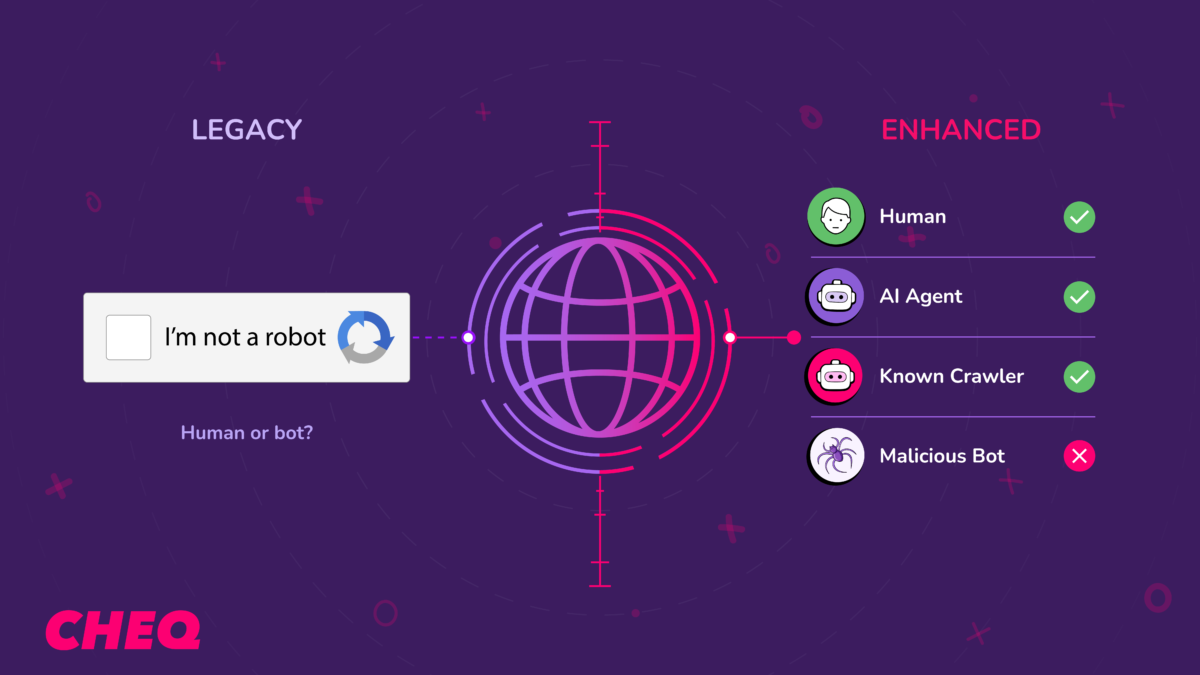
- Entity: what type of actor is making the request (a human, a bot, an AI agent, a known crawler)
- Identity: whose identity it presents, and whether the evidence supports the claim
- Intent: what its behavior suggests it is trying to do, from researching products to testing credentials
- Control: what response fits, from allowing and monitoring to rate limits, added verification, or refusing the request
Identity is the second of the four. It is necessary, and it is not sufficient.
That is why identity and intent are assessed separately. The difference between verifying an agent and reading its intent is deep enough to be its own topic.
How CHEQ Approaches AI Agent Identity
CHEQ treats identity as one pillar inside a broader approach that spans entity, identity, intent, and control.
In this frame, identity is the question of whether what an entity presents matches the real operator, platform, and ownership chain behind it. That check is how impersonation gets surfaced before it becomes a problem.
CHEQ’s relevance is the verified, inbound side: assessing agents and other automated entities arriving at a company’s websites, applications, and APIs, often without an account or credential to check against.
To corroborate a presented identity, CHEQ evaluates it against independent signals from an identity and threat intelligence network that processes approximately six trillion signals per day.
The result is a likelihood-based assessment of whether the presented identity is genuine, not a claim of certain attribution for every request. Some agents provide limited evidence, infrastructure is shared, and requests pass through intermediaries.
The customer keeps control of the response. The assessment informs the decision; it does not act automatically on the customer’s behalf.
For more detail, see how CHEQ assesses entity, identity, and intent. For the operational view, see a dedicated agent trust management approach.
Final Thoughts
AI agent identity splits into two responsibilities: assigning identities to the agents you operate, and verifying the identities of the agents that arrive with no account or credential.
The second cannot be solved with accounts and credentials alone, because the receiving organization may have no prior relationship with the agent.
Until external identity standards are universal, verification will depend on corroborating multiple signals and assigning an honest confidence level to each claim.
As agent traffic grows, that identity assessment is where governance starts, not where it ends.