Why Businesses Are Choosing CAPTCHA Alternatives
Jamie Vinkle
Bot & AI Agent Trust Management
September 01, 2026
-
Businesses are replacing CAPTCHA because it now falls short on every front it was meant to cover: automated tools solve it, real users abandon flows because of it, and it cannot account for legitimate automation.
-
Peer-reviewed research finds that automated systems match or beat humans on both solving speed and accuracy across widely deployed challenge types.
-
Challenges sit at signup, login, and checkout, which is exactly where friction is most expensive, and a measurable share of people abandon the task rather than finish it.
-
Visual and audio challenges create documented accessibility barriers, and score-based systems raise data-governance questions because of the behavioral data they rely on.
-
The newest failure mode is structural: a growing share of legitimate traffic is automated, and a test that asks “are you human?” has no good answer for it.
-
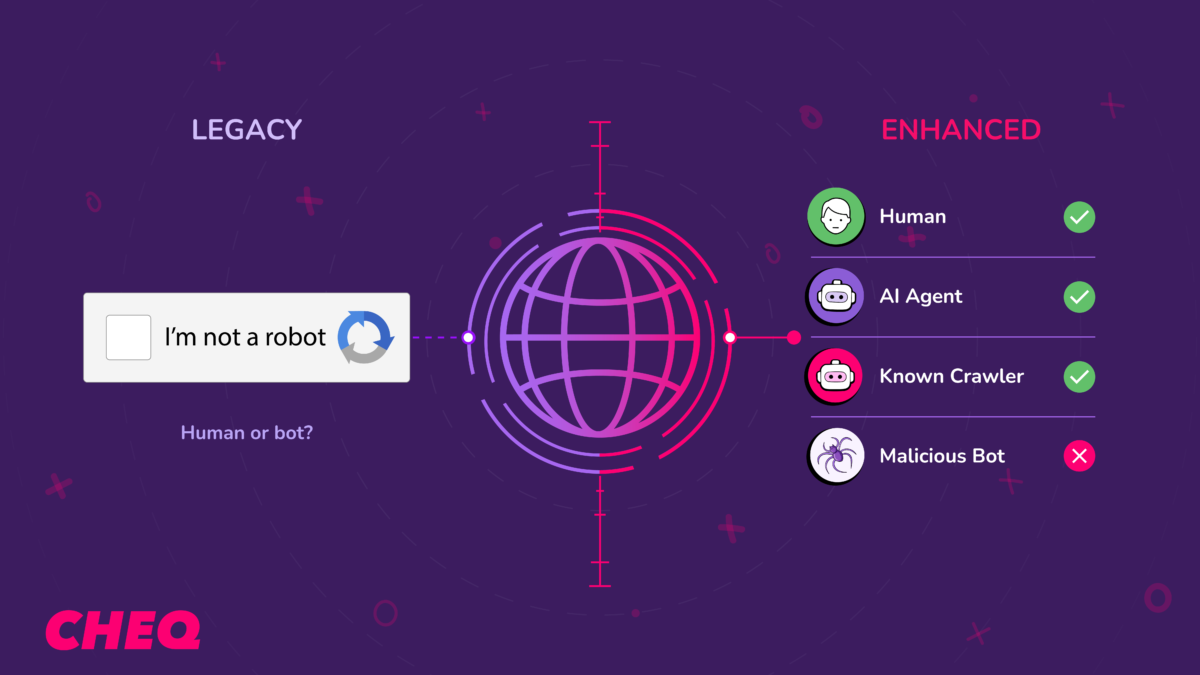
The durable replacement is not a harder or quieter human-test. It is a trust decision about each entity, paired with a response that fits the risk.
Businesses are choosing CAPTCHA alternatives because the model behind CAPTCHA now falls short on every front it was designed to cover.
Automated tools solve its challenges at least as reliably as people do, real users abandon signups and checkouts rather than complete them, and the test cannot tell the difference between automation that is hostile and automation that is working on a customer’s behalf.
Most teams reading this run reCAPTCHA, the most widely deployed implementation, and are feeling at least one of those costs directly.
This guide covers why the human-test model broke, what the main categories of CAPTCHA alternatives actually solve, and how to evaluate a replacement against the way your traffic looks today.
What CAPTCHA Was Designed to Do, and the Assumption That Broke
CAPTCHA was built to keep automated scripts out of forms, forums, and signups by asking for something easy for a person and hard for a machine.
The earliest versions, dating to the late 1990s, asked users to transcribe distorted text. The design worked on a simple premise about what bots are and how they work: software acting without a person behind it was, by definition, unwelcome.
The two names people use for this are not interchangeable, though they get treated that way. CAPTCHA is the category of challenge-response test; reCAPTCHA is Google’s implementation of it, and the one most sites actually run.
That premise encodes a binary. Every visitor is either a person to admit or a script to refuse, which makes a human-test a complete trust decision.
For the web CAPTCHA was born into, that description was close enough to true. Automation on a commercial site was overwhelmingly either a search crawler a business had already chosen to welcome or something it had no reason to serve, so sorting by species worked as a proxy for sorting by risk.
Two things have changed since. Machine capabilities caught up with the tests, and the traffic mix stopped being binary.
Why Businesses Are Moving Away From CAPTCHA and reCAPTCHA
Four costs are driving the move, and most teams feel more than one at a time.
Automated tools now clear the challenges reliably. Real users abandon the flows those challenges sit in. The challenges themselves create accessibility and data-governance exposure. And the test cannot recognize the growing share of automated traffic that businesses actually want.
Automated Tools Now Solve CAPTCHAs More Reliably Than People Do
The control has inverted its own purpose: determined automation gets through, while ordinary users struggle.
A USENIX Security study of 1,400 participants solving 14,000 CAPTCHAs found that human accuracy on image classification ran at roughly 81 percent, and concluded that bots can outperform humans on both solving time and accuracy across the CAPTCHA types tested.
Research from ETH Zurich went further, reporting a 100 percent solve rate against reCAPTCHAv2 image challenges using standard computer-vision models, compared with 68 to 71 percent in earlier work.
Outsourced solving is also an established commodity service, which means the challenge is a cost line rather than an obstacle for anyone motivated enough to pay it.
For the mechanics this section deliberately leaves out, see how automated tools get past CAPTCHA challenges.
CAPTCHA Friction Costs Signups, Leads, and Checkouts
Challenges appear exactly where a business wants speed, and a measurable share of real users leave rather than finish.
The same USENIX research ran a dedicated abandonment study: of 574 participants who started, 174 quit before completing, a 30 percent abandonment rate.
The context mattered more than the challenge itself. Participants solving CAPTCHAs inside an account-creation flow were 120 percent more likely to abandon than those solving the same challenges in isolation.
Mobile is where the experience is worst, because image grids and distorted text are hardest to work through on a small screen.
Lead-generation forms deserve particular attention, because a CAPTCHA added to filter spam quietly taxes every legitimate submission that follows. That tradeoff is why teams increasingly look at shielding lead-gen forms from automated submissions without putting a puzzle in front of the buyer.
Accessibility and Privacy Liabilities
CAPTCHA creates documented barriers for users with disabilities and raises real questions about the data it collects.
The W3C’s note on the inaccessibility of CAPTCHA states that asking users who are blind, visually impaired, or dyslexic to identify distorted characters asks them to perform a task they are “intrinsically least able to accomplish.”
Audio alternatives fare no better. The same note records test audio that was unintelligible to every test subject, all of whom had good hearing.
The W3C also observes that a design pattern expecting multiple attempts as a matter of course is “arguably inaccessible by design” to people living with anxiety disorders and a range of cognitive and learning disabilities. For organizations working to WCAG conformance, that is an experience problem and a compliance exposure at the same time.
Score-based systems trade the visible puzzle for background data collection. The ETH Zurich researchers found evidence that reCAPTCHAv2 relies heavily on cookie and browser-history data when assessing whether a visitor is human, which is precisely the kind of processing that consent and data-governance regimes ask organizations to justify.
CAPTCHA Cannot Tell Legitimate Automation From Hostile Automation
A test that asks “are you human?” has no good answer for legitimate traffic that is not.
A growing share of automation is working for a paying customer. AI agents research, compare, fill forms, and increasingly transact on someone’s behalf, alongside the crawlers, monitoring tools, and partner integrations businesses have always wanted.
The demand behind that shift is already visible. Adobe Analytics, drawing on more than a trillion visits to US retail sites, reported that traffic arriving from generative AI tools grew 693 percent year over year during the 2025 holiday season, with those visitors converting better than other sources.
Today most of that is a person clicking through from an assistant. The direction of travel is toward the assistant doing more of the work itself.
CAPTCHA has one response to all of it. Amazon’s developer documentation for agent browsing states the problem plainly: anti-bot mechanisms including CAPTCHA challenges are “designed to prevent malicious automated traffic but often block legitimate AI agents as well,” because websites “cannot reliably distinguish between legitimate agents and malicious bots.”
Both errors carry cost. The second kind, turning away legitimate automated demand, is new, and a human-test cannot avoid it by getting harder. Recognizing the difference is the work behind detecting malicious AI agents and synthetic interactions.
The Real Question Is Not “Human or Bot?”
Most CAPTCHA alternatives inherit CAPTCHA’s question and simply ask it more politely, which is why the more durable move is to change the question itself.
Not “is this a human?” but four questions that together describe an entity rather than sorting it.
This is the direction the industry is already moving, and the analyst community has renamed the category to match.
Forrester retitled its evaluation of this market to cover bot and agent trust management, and its analysis describes a market “evolving from a security-first mindset to a trust-first model that emphasizes understanding intent, distinguishing between good and bad automated traffic.” The same analysis notes that agents can represent legitimate customers, business partners, or malicious actors, which is a concession that agents are a permanent, governable part of traffic rather than something to filter out.
The standards work points the same way. Draft IETF specifications for HTTP message signatures on automated traffic let an agent cryptographically sign its requests, and Google’s crawling documentation describes the goal as moving “beyond easily spoofed headers to a verified identity.”
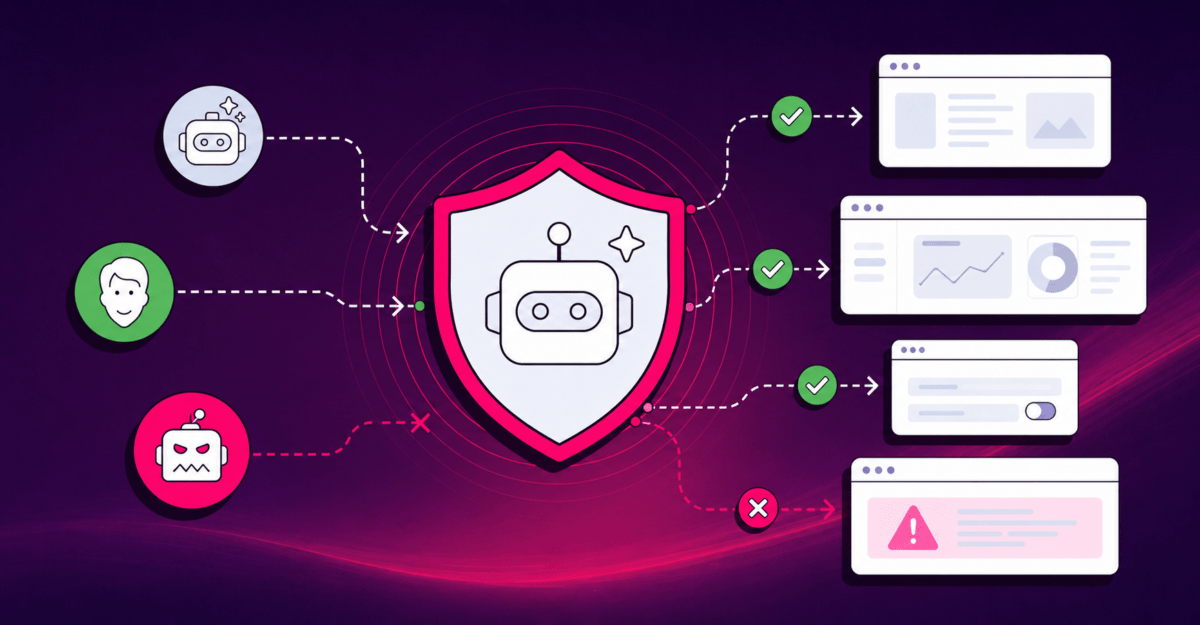
The second half of the shift is proportionality. Real traffic decisions are not binary, and between full access and full refusal sit monitoring, step-up checks, throttling, and constraining what a session is allowed to do.
A human-test offers none of that spectrum, which is the practical case for bot and agent trust management built on identity and intent.
Common CAPTCHA Alternatives and What Each One Actually Solves
Most CAPTCHA alternatives solve a narrower problem than their positioning suggests, so the useful comparison is scope rather than strength.
| Alternative Category | What It Handles Well | Where It Falls Short |
|---|---|---|
| Honeypot fields | Simple scripted form submissions, at almost no cost and with no visible friction | Anything adaptive works around it, and hidden fields can confuse screen readers |
| Anti-spam plugins | Comment and contact-form spam on common CMS platforms | Narrow scope; does not cover login, checkout, or browsing journeys |
| Web application firewalls | Known attack patterns and malicious payloads at the edge | Rule-based and IP-centric; a security layer rather than a way to govern automation |
| Multi-factor authentication and biometric verification | Account security at login and other authenticated moments | Cannot be enforced on anonymous journeys such as forms, browsing, or guest checkout |
| Invisible and managed challenges | Removing visible friction for the large majority of legitimate visitors | Still a human-test, so it inherits the same limits when the visitor is legitimately automated |
| Behavioral and device signal analysis | Assessing how a session behaves without posing a challenge at all | A signal layer rather than a complete decision framework on its own |
| Bot and agent trust platforms | Continuous entity-level assessment with graduated responses across all traffic | Requires policy ownership and calibration; more involved than a drop-in widget |
Here is what each category is actually for.
Honeypot fields are invisible form traps that catch submissions from scripts filling every input they find. They cost almost nothing and add no friction, which makes them worth keeping, but anything that reads the page adaptively steps around them. They also need care in implementation, because a hidden field that is not properly labelled can be announced to a screen reader and create the accessibility problem it was meant to avoid.
Anti-spam plugins filter comment and form spam at the CMS level. They do that job well and nothing beyond it, so they solve a content-moderation problem rather than a traffic-governance one.
Web application firewalls inspect requests for known attack patterns. They are a valuable security layer, and they are answering a different question than “should this automated visitor be here,” since their decisions lean on rules and IP reputation. An automated visitor that sends well-formed requests from a residential address raises nothing for a firewall to act on.
Multi-factor authentication and biometric verification raise assurance at login, where an account already exists. Neither can be applied to the anonymous parts of a journey, which is where most form and checkout abuse actually happens.
Invisible and managed challenges replace the visible puzzle with a background score or a proof-of-work test. The experience improves and the friction largely disappears for legitimate people, and the underlying question is unchanged, so a legitimate agent still has no way to pass honestly.
Behavioral and device signal analysis assesses how a session moves rather than asking it to prove anything. It is the foundation most modern detection is built on, and it works best as an input to a decision rather than as the decision. On its own it tends to answer how human-like a session looks, which is the old question wearing better clothes.
Dedicated bot and agent trust platforms assess each entity continuously and apply policy-based controls across humans, bots, and AI agents. This is the category-level answer to the reframed question, and it asks more of the team adopting it than a widget does.
Several of these are complements rather than replacements, and none of them is the single best option for every site. Honeypots and behavioral analysis sit comfortably alongside a broader system, and the right choice depends on which of the four failure modes is costing your business the most right now.
How to Evaluate a CAPTCHA Alternative
The strongest evaluations replace feature checklists with questions about how the system decides. Ask a prospective vendor:
- Does it verify silently for the vast majority of legitimate visitors, and what does the false-positive experience actually look like when it gets one wrong?
- Does it distinguish between kinds of automation, or does it only score how human-like a session appears?
- Can it recognize and admit declared, legitimate agents, including those presenting signed credentials, rather than treating all automation as hostile?
- What responses can it take between full access and refusal, and can those responses be set per journey?
- Does it explain its decisions in a way that fraud, security, and marketing teams can all act on?
- How does it handle privacy obligations and accessibility requirements out of the box, rather than as a configuration project?
Answers to the third question are worth particular attention, because the mechanisms for verifying the identity an arriving agent presents are changing quickly, and a system built only to score human-likeness has nowhere to put that signal.
The evaluation itself has shifted. The question is no longer which test is hardest to fool, but which system makes the most accurate trust decisions with the least friction.
How CHEQ Approaches Moving Beyond CAPTCHA
CHEQ approaches the problem as an entity-level trust decision rather than a human-test.
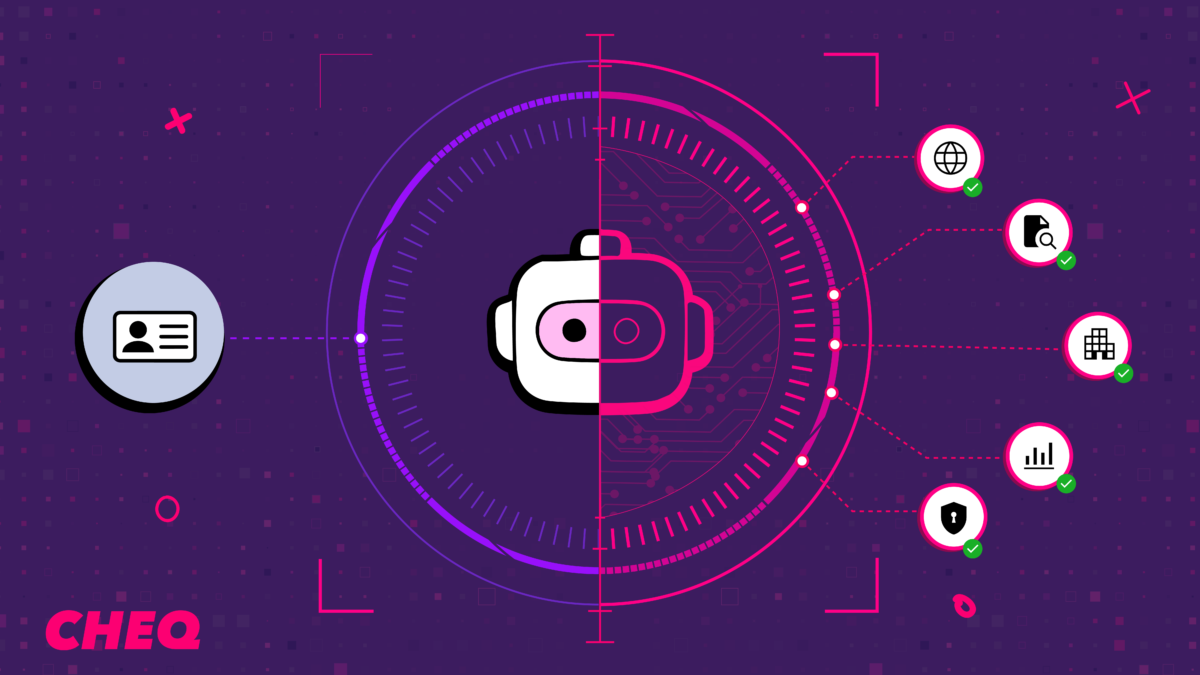
Instead of asking a visitor to prove humanity, the platform assesses what each entity is, whether the identity it presents is authentic, and what its behavior suggests it came to do. That assessment runs continuously across the website, apps, and APIs rather than at a single gate.
The reason for working this way shows up in what the network measures. Across 118 billion visits analyzed between April 2025 and April 2026, the largest single category of flagged automated activity was general automation tooling rather than classic malicious bots. The traffic arriving at a signup form no longer sorts cleanly into people and attackers, which is exactly the condition a human-test is worst equipped to handle.
The response is proportional rather than binary. Between allowing and refusing sit monitoring, step-up checks, constraining what a session can reach, throttling, and misdirection, so a low-confidence signal does not have to be treated the same way as a confirmed one.
One scope note matters here. CHEQ surfaces signals and a classification with the supporting evidence behind it, and the customer decides the response. Intent is an informed inference drawn from behavior and history, not a certainty about what any single agent will do.
For teams evaluating a replacement, that is what changing the question looks like in practice: not whether a visitor is human, but what it is, whether it is who it claims to be, and what response fits. The detail on how CHEQ assesses entity, identity, and intent covers how that works across humans, bots, and AI agents, without putting a challenge in front of legitimate visitors.
Final Thoughts
CAPTCHA is not failing because the puzzles got too easy. It is failing because the question behind them stopped describing the traffic.
A test that sorts visitors into people and scripts made sense when those were the only two things arriving. It holds up poorly now that determined automation can answer it and legitimate automation cannot.
That is why swapping one challenge for a quieter challenge tends to disappoint. The friction improves and the structural problem stays where it was, because the replacement is still asking whether the visitor is human.
The more durable move is to change what gets asked: what is this entity, is the identity it presents authentic, what does its behavior suggest it intends, and what response fits that read.
Answering those four questions well is harder than showing a puzzle. It is also the only version of this that still works when a growing share of your best customers arrive with something automated acting on their behalf.