AI Traffic Conversion Rates: How AI Agents and AI-Referred Shoppers Buy Compared With Humans
Spencer Bossi-Johnson
Agentic Web
October 21, 2026
AI traffic converts at a higher rate than human traffic, but only where the journey works. Across 14 retailers, shoppers referred by AI assistants bought at 2.5 times the human rate on desktop (3.9% vs. 1.6%). Shoppers who let an AI agent help inside their own browser bought at about four times the human rate (7.1%). On mobile, where 86% of AI-referred shoppers arrive, the rate falls to 0.6%, well below the 1.7% human rate. That is where most of these sales are lost.
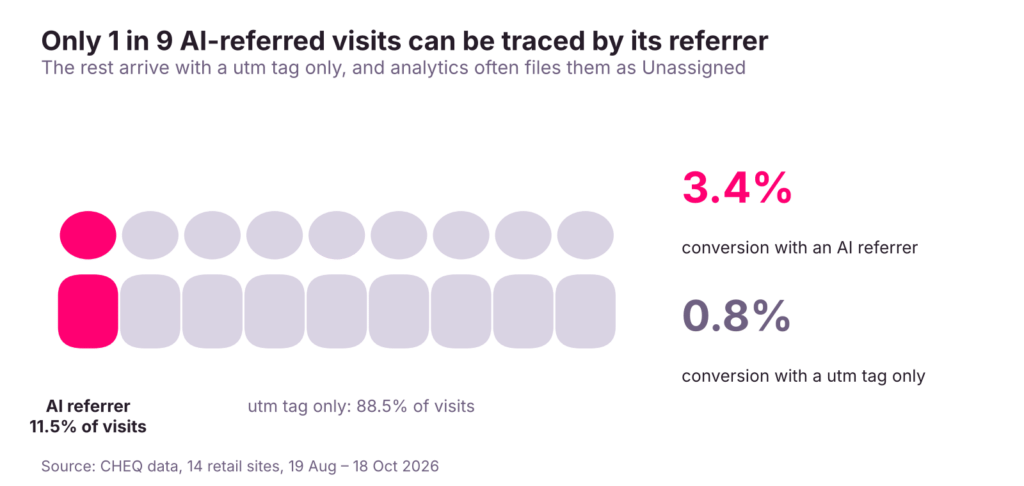
In 60 days, those 14 retailers received about 1.8 million visits from AI assistants and 99,000 visits from AI agents. Only 1 in 9 of the AI-referred visits carried an AI referrer. Some of these shoppers clicked a link in a ChatGPT or Claude answer, while others let an AI agent, such as Claude in Chrome, OpenAI Codex, or Meta’s Muse, browse the site for them. Standard analytics records most of these visits as ordinary traffic, making it hard to know which ones buy and where they give up.
We followed visits on 14 fashion, beauty, outdoor, DIY, home, and electronics retailers, from the first page to order confirmation. Below, we break down how human, AI-referred, and AI agent traffic convert, which assistants and agents bring the most valuable visitors, where those journeys stall, and what to fix first.
-
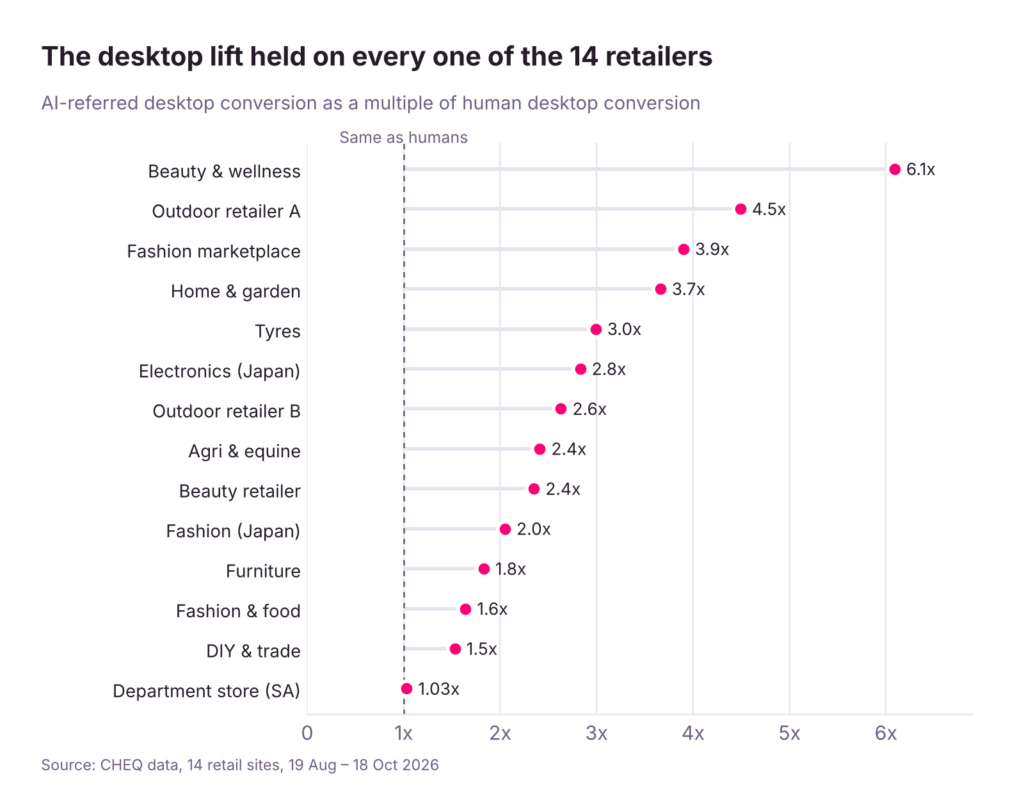
AI shoppers convert better on desktop: AI-referred visitors are higher-intent shoppers, buying at 2.5x the human rate on desktop on every one of the 14 sites. Visits where an in-browser agent helped the shopper converted at about 4x the human rate.
-
Most AI-referred traffic is credited to the wrong source: Only 1 in 9 AI-referred visits arrived with an AI referrer. The rest arrived with a utm tag, which many analytics setups file as Unassigned.
-
Mobile is where AI-driven sales are lost: 86% of AI-referred visitors arrived on a phone, and they converted at 0.6%, against 1.7% for human mobile visitors.
-
People let agents shop, but they make the final decision: Agents handed control back on 1 in 3.5 basket and checkout pageviews, against 1 in 8.5 elsewhere. Each hand-back is a chance for the sale to stall.
-
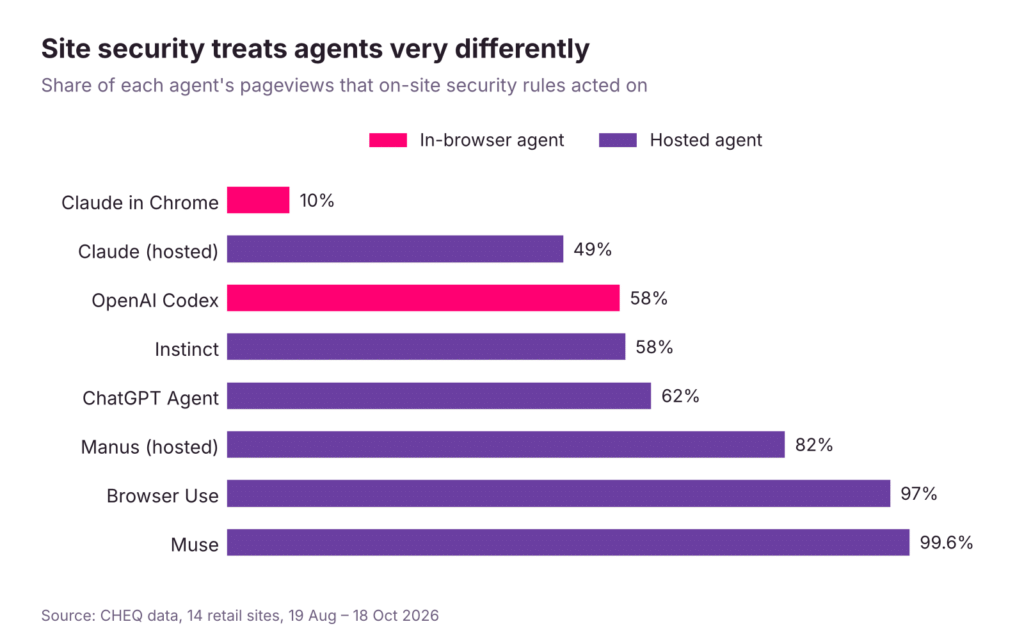
Blocking every agent turns away buyers: Site security acted on 10% of Claude in Chrome pageviews but on nearly every Muse pageview, so a policy for each agent works better than a blanket block.
What’s the Difference Between Human, AI-Referred, and AI Agent Traffic?
When it comes to agentic commerce sales, three types of traffic matter most: people who browse on their own, people sent by an AI assistant, and people who hand the browsing to an AI agent. Each one shops differently, but most analytics tools count all three as one audience, which hides where each group converts and where it drops off.
- Human traffic: A person finds your site through search, ads, email, or a direct visit, then browses and buys on their own. This is the baseline the other two groups are measured against.
- AI-referred traffic: A person asks an AI assistant, such as ChatGPT, Claude, Gemini, or Perplexity, a question, clicks a link in the answer, and lands on your site. They stay in control the whole time, but referrer data often misses the source. Across the 14 retailers, referrer data identified only 1 in 9 of these visits, because most arrived with a utm tag rather than an AI referrer.
- AI agent traffic: An AI agent browses, compares, and sometimes checks out on a person’s behalf. AI browser agents, such as Claude in Chrome or OpenAI Codex, work inside the person’s own browser and can hand control back at steps like payment. Hosted agents, such as ChatGPT Agent, Manus, Instinct, and Meta’s Muse, run in their own browser from start to finish.
| Traffic Type | Who’s Browsing | How They Arrive | Examples | Who’s in Control at Checkout | How Standard Analytics Usually Records It |
|---|---|---|---|---|---|
| Human traffic | A person, on their own | Search, ads, email, or a direct visit | Not applicable | The person | By channel, as ordinary traffic |
| AI-referred traffic | A person, after asking an AI assistant a question | Clicks a link in the AI’s answer | ChatGPT, Claude, Gemini, Perplexity | The person | Often under another source, because most visits arrive with a UTM tag rather than an AI referrer (referrer data identified only 1 in 9) |
| AI agent traffic (in-browser) | An AI agent, inside the person’s own browser | The person hands a task to the agent mid-visit | Claude in Chrome, OpenAI Codex | The agent, until it hands control back at steps like payment | As an ordinary customer session |
| AI agent traffic (hosted) | An AI agent, in its own cloud browser | The agent visits on the person’s behalf | ChatGPT Agent, Manus, Instinct, Meta’s Muse | The agent, from start to finish | Often as an ordinary shopper |
Does AI Traffic Convert Better Than Human Traffic?
On desktop, yes, on every site we analyzed. The gap was widest when a shopper used an AI agent inside their own browser.
Across 14 retailers, with data measured from August 19 to October 18, 2026:
- Human visitors: 1.6% purchase rate on desktop, 1.7% on mobile
- AI-referred visitors on desktop: 3.9%, about 2.5 times the human rate
- AI-referred visitors on mobile: 0.6%, about a third of the human rate
- Visits where an in-browser AI agent helped the shopper: 7.1%, about four times the human rate
- Visits by hosted agents, such as ChatGPT Agent: 0.2%
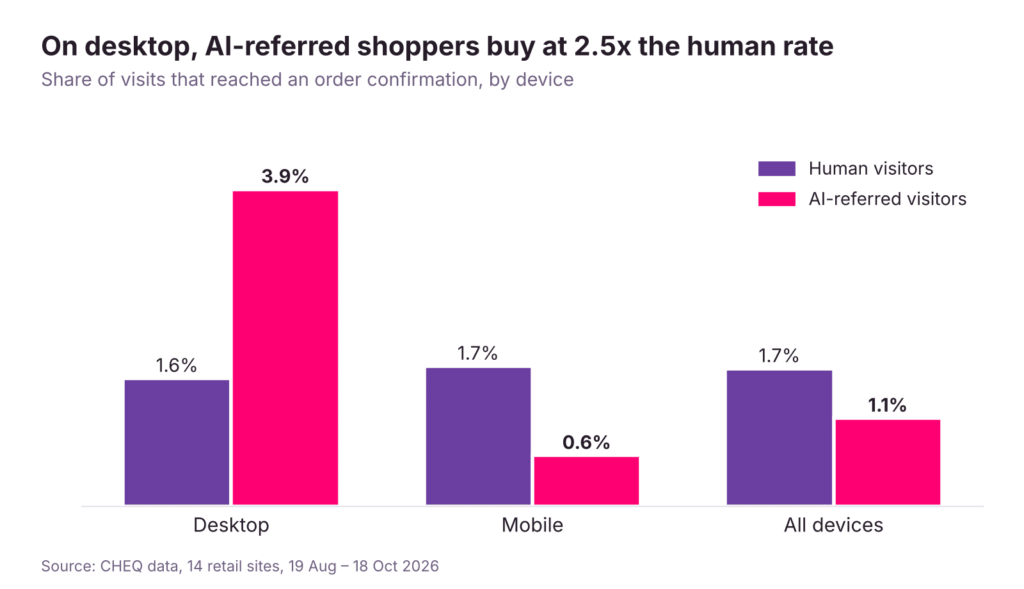
AI-referred desktop visitors out-converted human desktop visitors on all 14 sites. Because most AI-referred visitors arrive on a phone, AI-referred traffic as a whole converted at 1.1%, below the 1.7% human rate. Retailers that look only at a blended rate will miss both the opportunity and the leak.
Agent-assisted visits are a much smaller group, so treat the 4x figure as an early signal rather than a benchmark.
Where the AI source is visible, intent is clear. AI-referred visits that carried an AI referrer converted at 3.4%, twice the human rate.
Outside data also backs this up. Adobe found AI referrals to U.S. retail sites converted 42% better than non-AI traffic in March 2026, up from 38% worse a year earlier. Semrush reached a similar conclusion, estimating that the average AI search visitor is worth 4.4x a traditional organic search visitor, based on conversion rate.
Why AI visitors buy more often
One likely reason AI visitors buy more often is that the AI has already done part of the research, so visitors arrive closer to a decision and go straight to what they came for.
- AI-referred desktop visitors viewed 4.9 pages per visit, compared with 1.8 for human desktop visitors.
- Shoppers using an in-browser agent viewed 10.9 pages per visit.
A higher conversion rate isn’t the whole story, though. Many of these visitors still drop off on mobile and at checkout, which we cover in more detail below.
Which AI Assistants and Agents Drive the Most Sales?
Based on CHEQ data, ChatGPT sends the most AI traffic, but it doesn’t convert the best. Claude-referred visitors bought at a much higher rate, and in-browser agents far out-sold hosted ones. Here’s a snapshot across the 14 retailers, from August 19 to October 18, 2026:
- AI assistants
- ChatGPT: 97% of AI referral visits, 1.1% conversion (4.0% on desktop)
- Claude: 5.5% conversion, about five times ChatGPT, with visits running about four times deeper (8.1 pages vs. 2.1)
- Gemini, Copilot and Perplexity: 1.0% to 1.8% conversion
- AI agents
- Claude in Chrome: 8.4% of visits ended in an order, at 12.9 pages per visit
- OpenAI Codex: 5.1% of visits ended in an order, at 7.8 pages per visit
- Browser MCP: 24 orders from 93 visits. Volume was very low, but it was the most purposeful behavior we saw
- ChatGPT Agent: 71% of all agent visits, but 0.1% ended in an order, usually after a single page
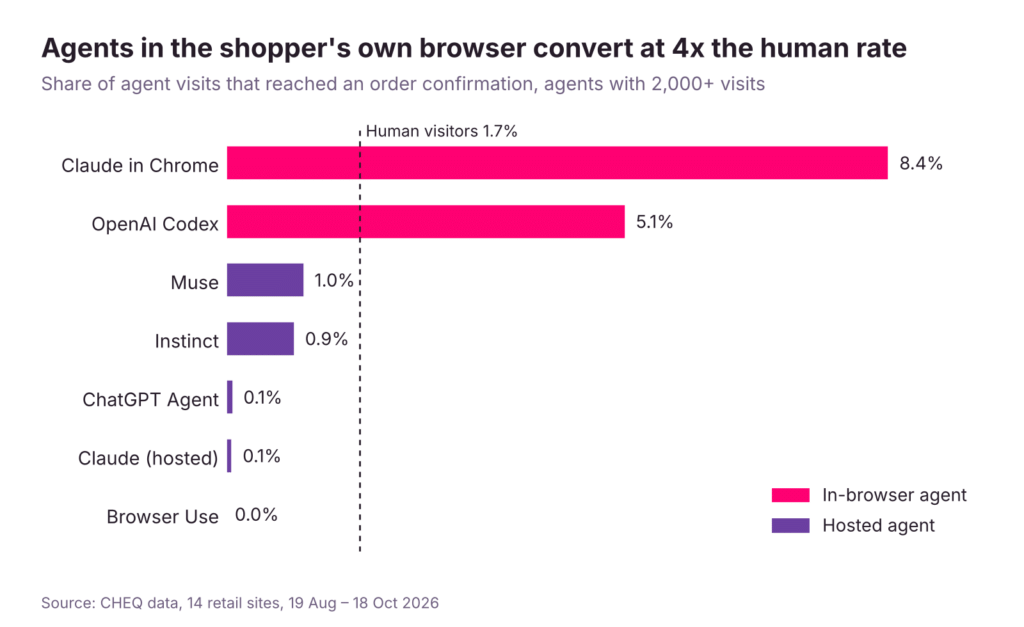
Claude’s and Browser MCP’s figures come from smaller samples, so treat them as directional.
Where Do AI Shoppers Drop Off Before Buying?
AI shoppers who don’t buy tend to drop off on mobile, and at the steps where an agent hands control back to the person.
Why does AI-referred traffic convert worse on mobile?
Most AI-referred visitors arrived on a phone, and mobile loses most of them. Across the 14 retailers:
- 86% of AI-referred visitors arrived on a phone, compared with 78% of human visitors
- On desktop, they bought at 2.5x the human rate (3.9% vs. 1.6%)
- On mobile, they bought below the human rate (0.6% vs. 1.7%)
- AI-referred mobile visitors viewed 1.7 pages per visit, against 4.9 on desktop
The gap held on most sites: AI-referred mobile visitors converted below human mobile visitors on 9 of the 14. Most arrived with a ChatGPT utm tag and no referrer, which suggests taps from inside the ChatGPT app. So, the intent is there, but the mobile landing page and checkout aren’t keeping up.
Where do AI agents hand control back to humans?
At the basket and checkout. People let agents research, compare, and fill the basket, but they keep the card.
- In-browser agents handed control back on 1 in 3.5 basket and checkout pageviews, compared with 1 in 8.5 pageviews elsewhere on the site.
- A quarter of in-browser agent visits included at least one hand-back.
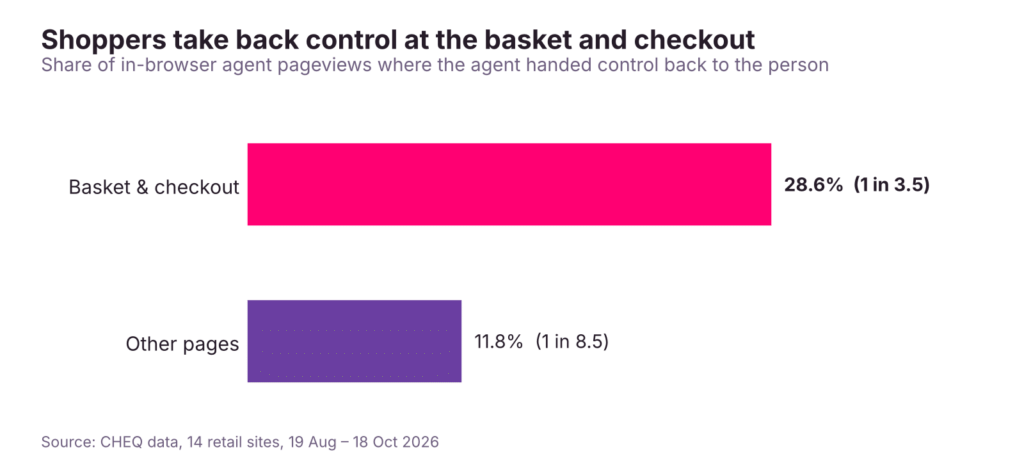
Each hand-back is a point where the person can give up. If sign-in or payment is slow, the sale stalls.
Should You Block AI Agents on Your Website?
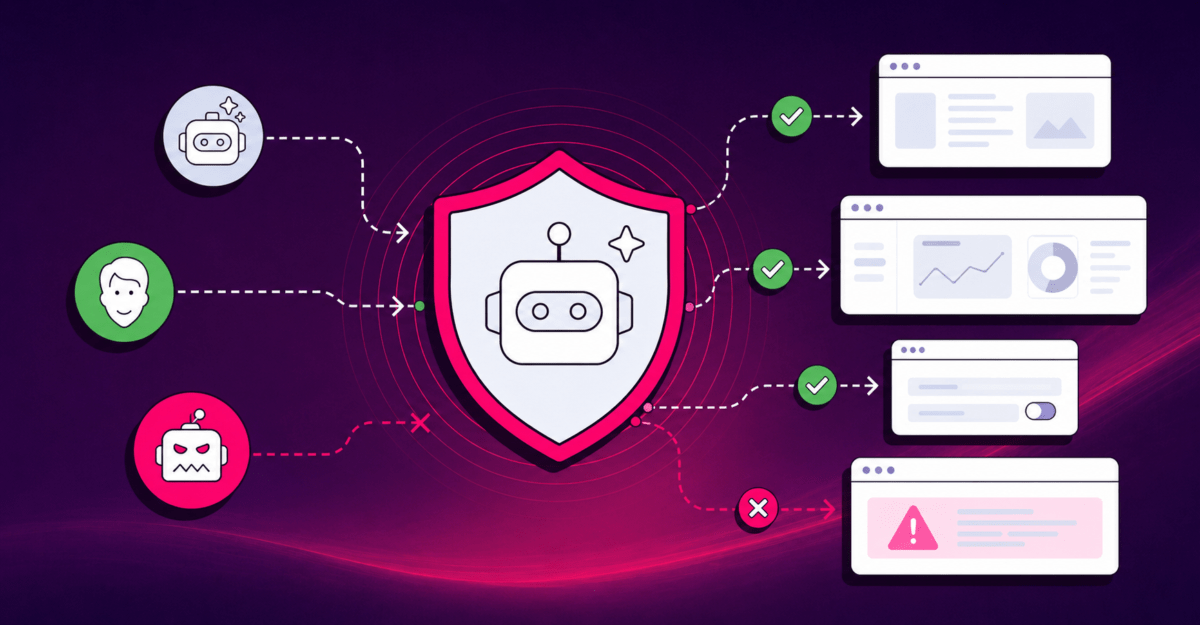
No, blocking every AI agent turns away high-intent customers who are ready to buy, and some agents are hit far harder than others. Across the 14 retailers, on-site security rules acted on 10% of Claude in Chrome pageviews, 62% of ChatGPT Agent pageviews, and 99.6% of Muse pageviews. The agent a shopper picks can decide whether the sale happens at all. Many of these agents are also hard to spot without AI agent identity verification, and standard analytics records them as ordinary shoppers.
Ignoring agents isn’t the answer either. Agents share your site with other bot traffic, including scrapers and malicious bots, and new agents keep arriving: CHEQ added detection for Muse and Instinct during the period we measured. The practical approach is creating a policy for each agent. Welcome the ones that bring in customers, challenge or block the ones behind web scraping attacks, promo code abuse, or fake account creation, and keep measuring so you can adjust as agents change.
How Can You Measure and Improve AI Traffic Conversion?
Start by measuring each traffic type on its own, then fix the drop-off points that cost you the most sales.
- Report conversion separately for human, AI-referred and AI agent traffic, and split each by device, as a blended rate hides the gaps.
- Count utm-tagged AI visits as AI traffic, since only 1 in 9 arrive with an AI referrer.
- Fix mobile first on the pages AI sends people to, since that’s where most AI-referred sales are lost.
- Shorten the hand-back points by making sign-in, basket and payment quick for a person taking over from an agent.
- Set a policy for each agent instead of blocking or allowing them all, using signals that help with detecting malicious AI agents.
- Judge AEO/GEO work by what happens after the click, not just by how often AI cites you.
How CHEQ Helps You Track AI Traffic
AI visibility tools tell you when an AI assistant cites your brand. CHEQ shows you what happens after the click.
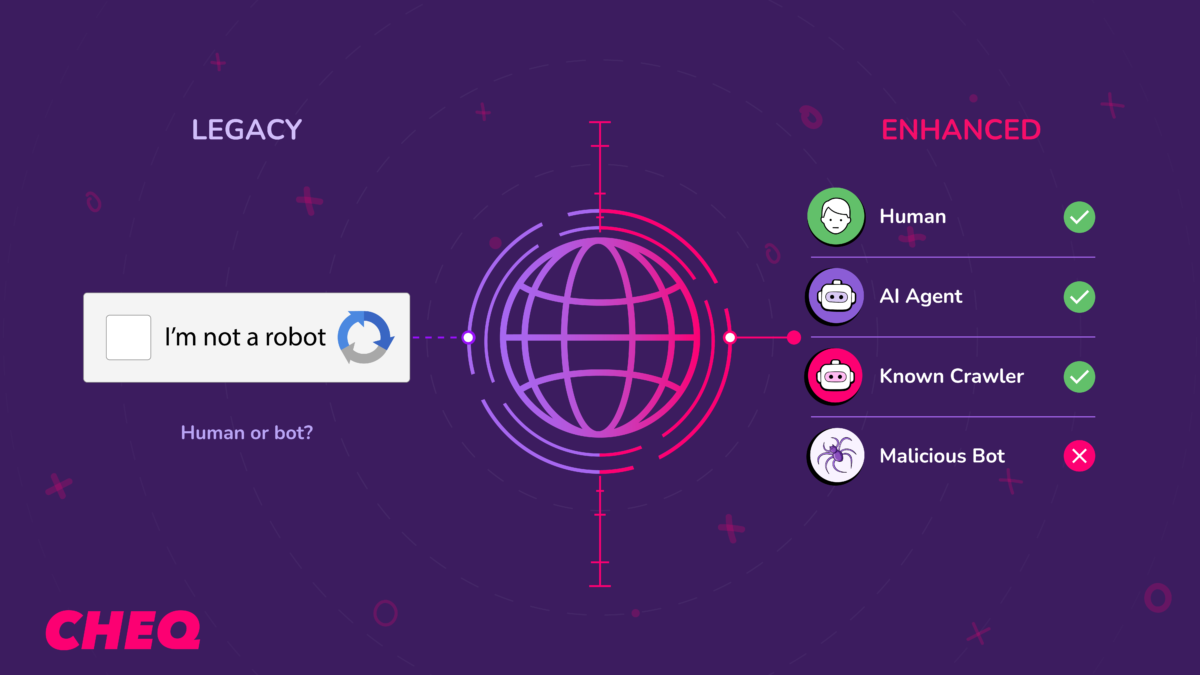
CHEQ gives you visibility into AI agents and bots on your site, identifying every visitor as one of five types (human, AI agent, crawler, scraper, or malicious bot) and flags the people who arrived from an AI assistant. From there, you can:
- Compare conversion for human, AI-referred, and AI agent traffic, by device, page, and assistant
- Recognize agents by name, including ChatGPT Agent, Claude in Chrome, Codex, Manus, Instinct, and Muse, and understand AI agent intent
- See when an in-browser agent takes over and when it hands control back to the person
- Follow each visit from the first page to order confirmation, so you can find where sales are lost
- Hold your AEO/GEO work to an independent baseline based on sales, not just citations
Want to see how AI agents and AI-referred visitors move through your site? Talk to our team!
Stop Blocking Buyers: Measure AI Agent Traffic Before You Act
AI is already a sales channel, and it doesn’t behave like human traffic. On desktop, AI-referred shoppers buy at 2.5 times the human rate, and visits where an in-browser agent helps the shopper buy at about four times it. Yet many of those sales stall on mobile and at the basket, where people take back control from the agent. Site security creates another gap: some agents are acted on for one pageview in ten, others for nearly every one.
Blocking every agent turns away buyers with real intent, while ignoring agents leaves the door open to scrapers and malicious bots. The retailers that win will be the ones that measure first. CHEQ shows you who’s on your site, how each type of traffic converts, and where AI-driven sales are lost, so your team can act on it.
Methodology
This analysis uses CHEQ Analytics data from 14 retail websites, anonymized for confidentiality: fashion, beauty, outdoor, DIY, home, and consumer electronics retailers in the UK, Europe, Japan, and South Africa, from August 19 to October 18, 2026.
- Selection: Sites were included only if they had a verified order-confirmation page or purchase event, and at least 1,000 AI-referred visits and 30 AI-referred orders in the period.
- Classification: CHEQ identified each visit as human, AI-referred, or AI agent. AI-referred visits came from an AI assistant referrer or an assistant utm tag. Agents were recognized by their fingerprint; in-browser agents were also tracked as they took over and handed back control.
- Conversion: The share of visits (one visitor on one day) that reached order confirmation. For AI-referred visits, only orders after the AI-referred click count.
- Comparisons: Human rates come from a random 5% sample of about 42 million visits. Visits CHEQ flagged as invalid traffic were excluded from the human and AI-referred groups.
- Scope: No traffic was blocked; every visit was measured. Agent and Claude figures are based on smaller samples and should be read as directional.

Author
Spencer Bossi-Johnson
As Senior Content Marketing Manager at CHEQ, Spencer helps brands make sense of a web where humans and AI agents share the customer journey. With eight years in SEO and GEO content strategy, he knows how to write for people and the machines that recommend content to them.